Did you enjoy playing with Lego as a child or tinkering with tiny components? Then you should continue to pursue your passion for tools and machines in the future and do an apprenticeship which requires precise working. Precision mechanics manufacture metal precision parts for machines and equipment and assemble these - like Lego bricks - to create a functional unit. In most cases, precision mechanics use computer-controlled machine tools (CNC), but sometimes they do the work manually, for example,
in the production of prototypes.
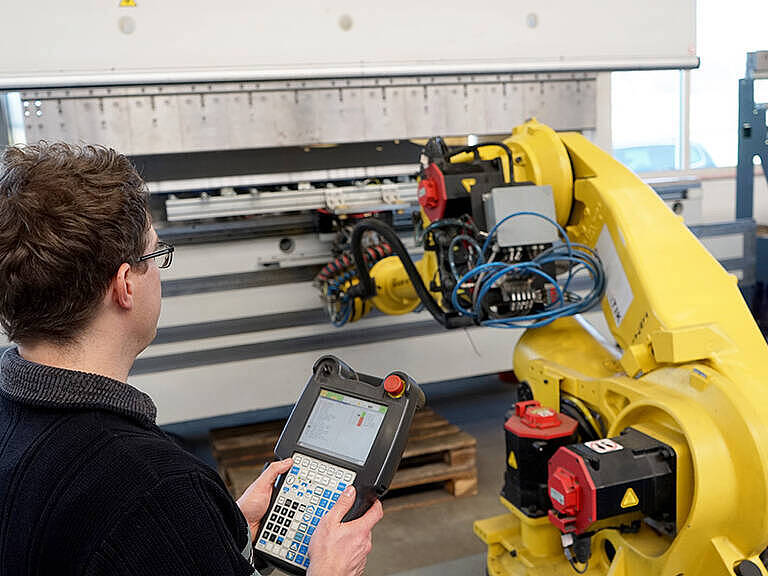
The precision mechanic plans work processes, sets up machine tools and machines metal using methods such as turning, milling, drilling, grinding and honing. The precision mechanic’s responsibilities also include the subsequent review of the work results, as well as the assembly of modules to create the finished forwarding tractor.
You can see that being a precision mechanic requires a lot of intuition, sensitivity and precise working. Precision engineering therefore is a very varied and demanding profession, which has a lot more to offer than you would imagine at first.
School/workplace:
Automotive mechatronics technicians know how to install, service, repair and replace mechanical, electronic and mechatronic components. As vehicle technology advances, work on the motor vehicle has changed: Of course, wrenches and oil rags are still part of the basic equipment of a motor vehicle mechatronic technician, but he should also be able to deal with computer-controlled test equipment. In addition to the installation of the complete electronics in the special forestry tractors, you also learn how to use diagnostic tools.
Metal workers specialising in commercial vehicle production make vehicle frames, bodies, chassis and superstructures for vehicles and machines, e.g. in agriculture and forestry.
They manufacture components made of steel or sheet metal from drawings or blueprints. They mark the metal, cut and form it. They weld and bolt together in individual components. In assembly work, they also use prefabricated parts and systems. They install hydraulic, pneumatic and electronic equipment or combine assemblies to create larger items of equipment, such as Loading cranes for loading work in the forest.
They remove damaged components to repair or replace them.
As a warehouse logistics specialist, your daily tasks will cover all logistics areas.
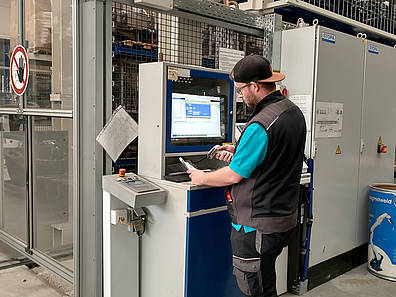
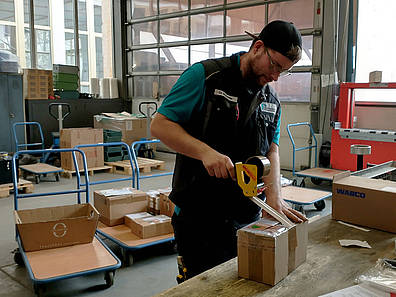
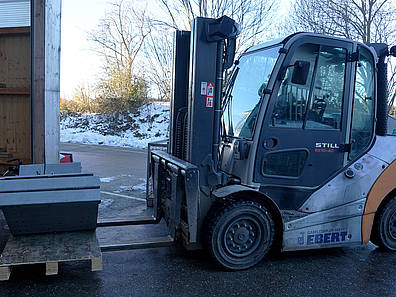
After receiving the goods in a controlled manner, you will book them into our system and then bring them to their correct storage location. You will also be operating our high-bay racks and the automated large warehouse. However, your area of responsibility will include not only the incoming goods department, but also the outgoing goods department. After a customer or dealer has placed an order, you will compile the ordered items, carry out any necessary assembly work and then pack them. Your area of responsibility may also include the unloading of trucks.
Duration of training:
3 years
School leaving qualification:
For the training, you will need a school leaving certificate (equivalent to the German “qualifizierter Mittelschulabschluss” or “Realschulabschluss”)
School/workplace:
Apprenticeship as a precision mechanic (specialising in mechanical engineering) and subsequent mechanical engineering studies with in-depth practical experience
Do you have a high school diploma, a subject-specific higher education entrance qualification or a technical college entrance qualification?
Would you like to combine theory and practice?
Are you characterised by motivation and performance?
Then apply now for a dual study programme at Pfanzelt Maschinenbau, because here you can apply the theoretical knowledge you have acquired in real practical projects at the same time.
Apprenticeship as a precision mechanic (FA Mechanical Engineering)
The precision mechanic produces precision metal parts for machines and devices and assembles them into a functional unit. In most cases, precision mechanics use computer-controlled machine tools (CNC) to do this, but sometimes they also carry out the work manually, for example in the production of prototypes.
Precision mechanics plan work processes, set up machine tools and machine metal using cutting processes such as turning, milling and drilling. Their area of responsibility also includes the subsequent inspection of the work results, as well as the assembly of components through to the finished tractor.
As you can see, the profession of precision mechanic requires a great deal of sensitivity, finesse and precision work. In return, however, it offers a very varied and challenging field of work that has much more to offer than you might imagine at first glance.
Study with in-depth practical experience (mechanical engineering)
From vehicles to machine tools, from creative ideas to production - as a mechanical engineer, you will help shape the development of our machines from conception to use. By the end of your studies, you will be excellently trained to apply the diverse knowledge and methods of mechanical engineering in your future fields of work.
The course of study is characterised by alternating phases at the university and in the company.
The lecture-free period is used for the practical application of the theoretical course content. The degree programme with in-depth practical experience ends with a company-related Bachelor's thesis at Pfanzelt.
Apprenticeship as a precision mechanic (min. 2 years)
Study programme with in-depth practical experience at Kempten University of Applied Sciences (at least 3.5 years)
Contact training officer
Our training officers, Angelika Heel and Simon Hengge, will be happy to answer any further questions you may have. If you would like to have a taster, you can also make an appointment for an internship.
Phone +49 (0) 8860 / 92 17 - 0
E-mail: ausbildung@pfanzelt.com
WhatsApp: +49 (0) 170 3744034